rabbit anti-cre #69050 (Millipore)

90
Structured Review
Millipore
rabbit anti-cre #69050

Rabbit Anti Cre #69050, supplied by Millipore, used in various techniques. Bioz Stars score: 90/100, based on 1 PubMed citations. ZERO BIAS - scores, article reviews, protocol conditions and more
https://www.bioz.com/result/rabbit anti-cre #69050/product/Millipore
Average 90 stars, based on 1 article reviews
Rabbit Anti Cre #69050, supplied by Millipore, used in various techniques. Bioz Stars score: 90/100, based on 1 PubMed citations. ZERO BIAS - scores, article reviews, protocol conditions and more
https://www.bioz.com/result/rabbit anti-cre #69050/product/Millipore
Average 90 stars, based on 1 article reviews
rabbit anti-cre #69050 - by Bioz Stars,
2026-02
90/100 stars
Images
1) Product Images from "Multiple phosphatidylinositol(3)phosphate roles in retinal pigment epithelium membrane recycling"
Article Title: Multiple phosphatidylinositol(3)phosphate roles in retinal pigment epithelium membrane recycling
Journal: bioRxiv
doi: 10.1101/2020.01.09.899815
Figure Legend Snippet: ( A ) Plasmids expressing GFP (A, far left panel) or the PI(3)P probe GFP-2xHrs (A-D) were injected subretinally and electroporated to transfect RPE cells. Flatmount RPE (A, middle panel) and vertical eyecup sections (A, far right panel) confirmed expression in the RPE layer and punctate localization of GFP-2xHrs. ( B, C ) Eyecup section (B) and RPE flatmount (C) from control mice injected with GFP-2xHrs to mark PI(3)P and labeled with 1D4 antibody to mark POS phagosomes in RPE. ( D ) Cre immunostaining in flatmount electroporated RPE revealed mosaic expression of Cre in the Vps34 ΔRPE mice. Punctate localization of GFP-2xHrs was lost in Cre-positive KO cells ( i, ii ), but maintained in Cre-negative cells (arrow). The green channel is over-saturated in ii to show the dimmer puncta in Cre-negative cells. ( E ) Punctate endosomal localization of PI(3)P-binding protein EEA1 was disrupted in KO cells, identified by accumulation of p62
Techniques Used: Expressing, Injection, Control, Labeling, Immunostaining, Binding Assay
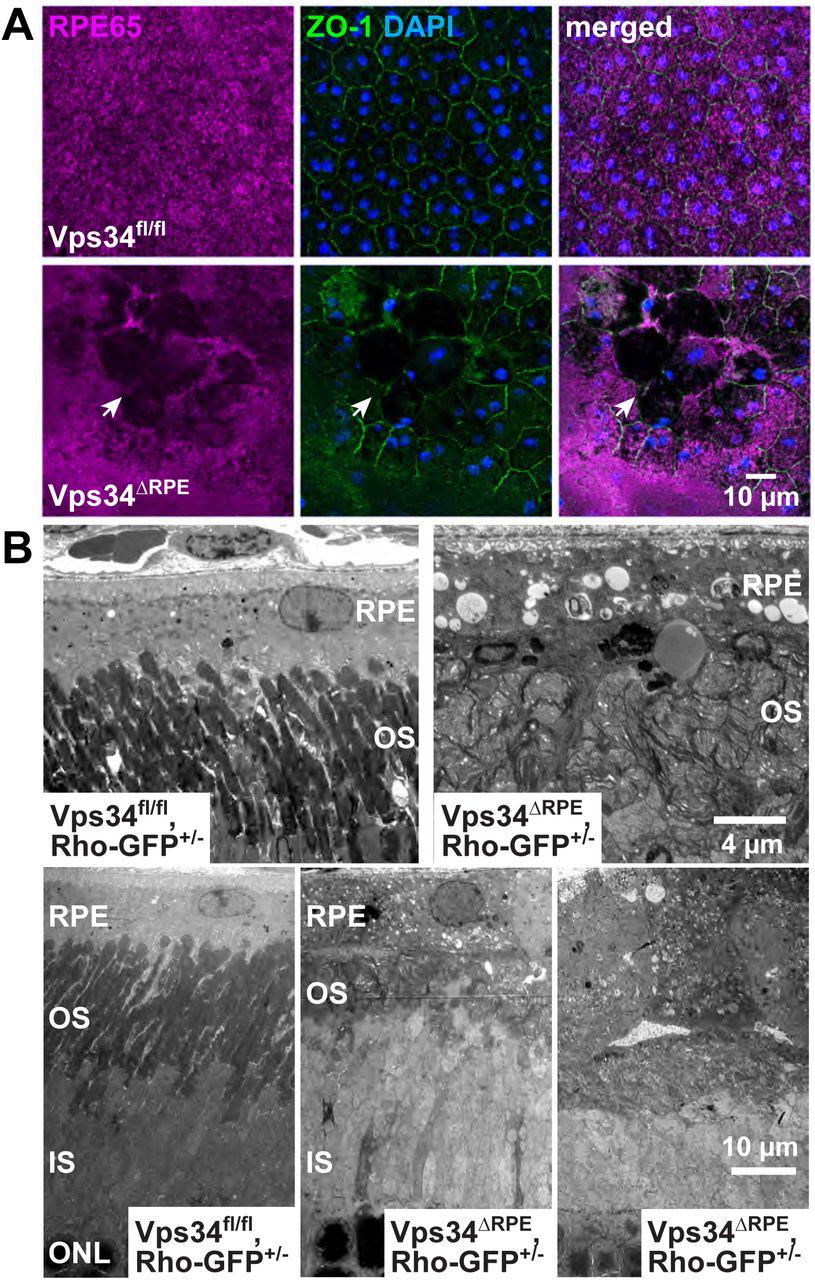
Figure Legend Snippet: ( A ) Immunostaining for RPE65 and the tight junction protein ZO-1 in RPE flatmounts indicate abnormal morphology and cell death in the KO mice. ( B ) Abnormal morphology of both RPE cells and photoreceptor outer segments was observed by TEM of eyecup sections.
Techniques Used: Immunostaining
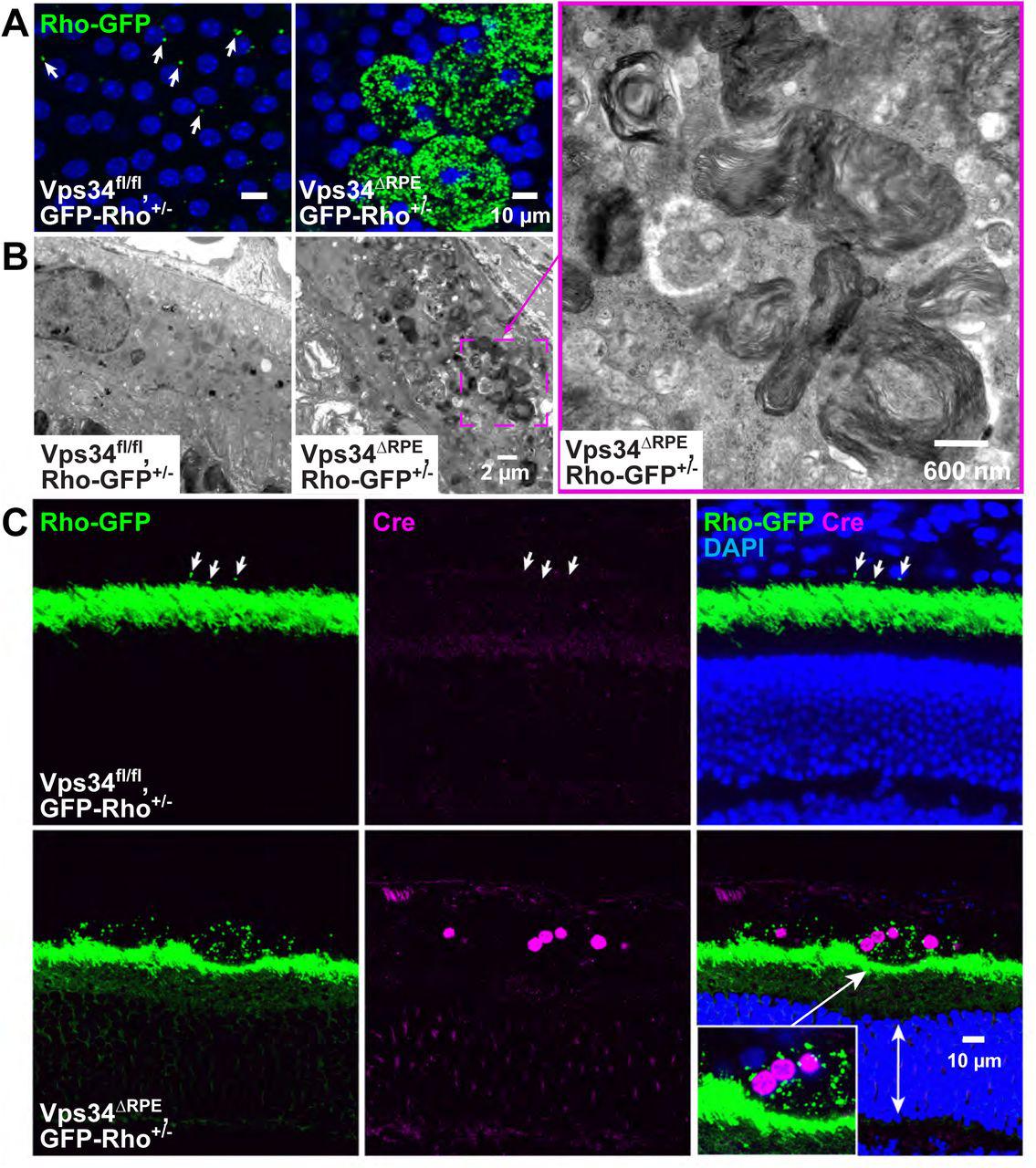
Figure Legend Snippet: ( A ) RPE flatmount from control (left) and Vps34 ΔRPE mice (right) alsoexpressing Rho-GFP show accumulation of Rho-containing phagosomes in KO RPE cells. ( B ) TEM from a region containing accumulated POS-containing phagosomes. ( C ) Eyecup sections from mice of same genotypes as in A, with immunostaining for Cre, showing the highest number of phagosomes in the Cre-positive regions.
Techniques Used: Control, Immunostaining

Figure Legend Snippet: ( A ) In hRPE1 cells treated with CQ, Rab11a did not colocalize with WIPI2. ( B ) Rab11a immunostaining of ARPE-19 cells transfected with Rab11a-shRNA and treated with CQ confirmed effective knockdown. Transfected cells were identified by GFP expression from a separate expression cassette in the shRNA plasmid. ( C ) WIPI2 puncta in ARPE-19 cells were unaffected by Rab11a knockdown, in either absence or presence of acute VPS34-IN1 treatment.
Techniques Used: Immunostaining, Transfection, shRNA, Knockdown, Expressing, Plasmid Preparation
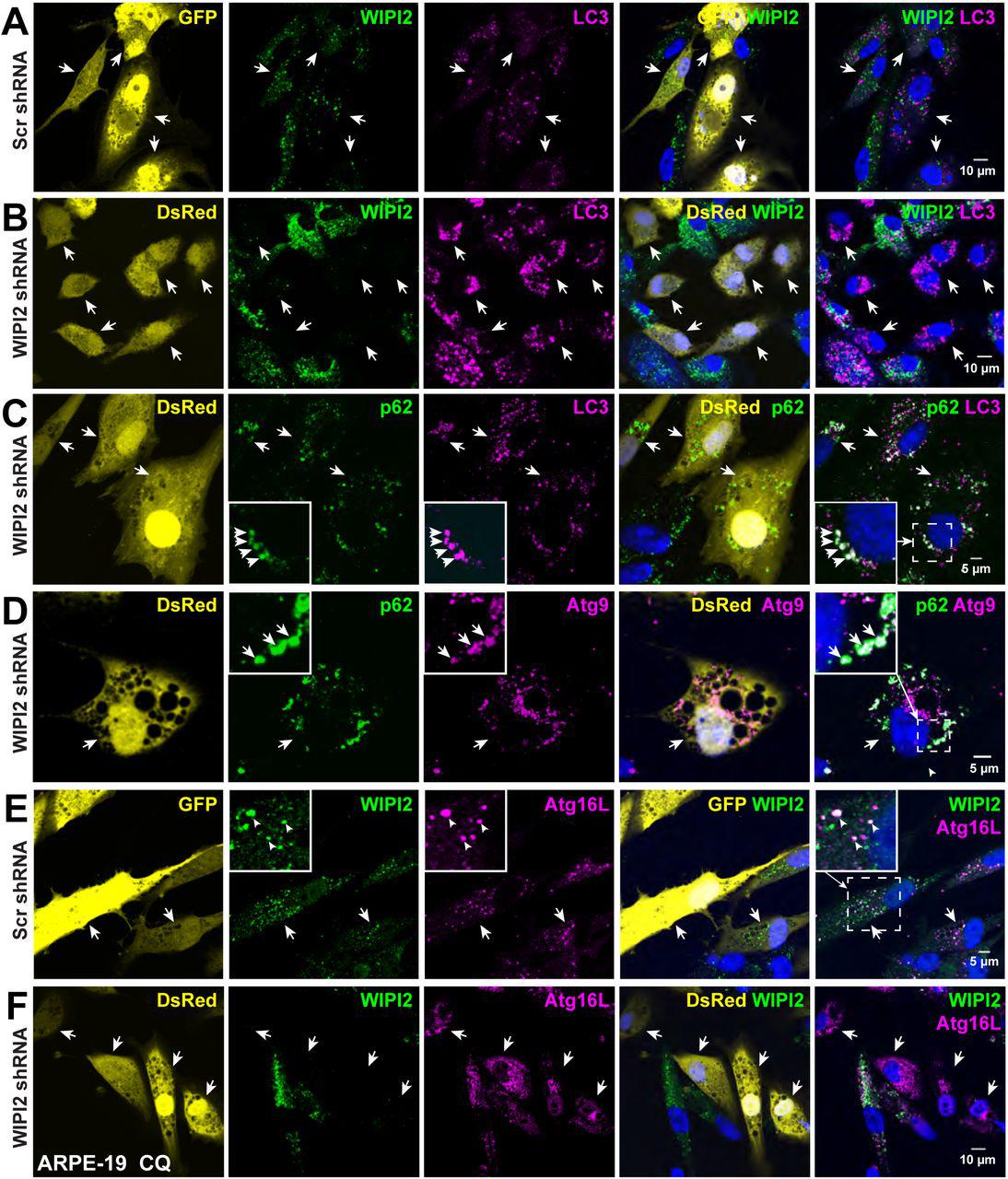
Figure Legend Snippet: ( A,B ) ARPE-19 cells were transfected with scrambled (A) or WIPI2 (B) shRNA, marked by GFP or DsRed expression, respectively. WIPI2 immunostaining confirmed knockdown efficiency; LC3 puncta were unaffected. ( C,D ) Puncta formed in WIPI2 knockdown cells contain LC3, p62, and Atg9. ( E ) In ARPE-19 cells transfected with scramble shRNA control, WIPI2 puncta colocalize with Atg16L. ( F ) Atg16L1 puncta were maintained in WIPI2 knockdown cells.
Techniques Used: Transfection, shRNA, Expressing, Immunostaining, Knockdown, Control